
Comparisons / VoyaX Mossa
Head-to-head comparison
FluxJet vs VoyaX Mossa 128: Electric Jet vs Pedal-Electric Hybrid
Two of the most talked-about motorized fishing kayaks right now take completely different approaches. The VoyaX Mossa is a pedal kayak with electric assist, and the Mossa series won Best of Show in the Boats and Watercraft category at ICAST 2026. FluxJet is pure electric jet drive: the ICAST 2025 Best of Show winner and the 2026 Yak Tribe People's Choice Award winner for Best Motorized Kayak, voted by more than 33,000 anglers.
Both are well engineered. They solve different problems, so here's how to tell which one fits the way you fish.
The 30-second verdict
Which one should you pick?
Choose FluxJet if you want
- Pure electric power with no pedaling
- To motor through skinny water: about 4 inches, with nothing hanging below the hull
- Fewer things to snag in weeds: no prop, no pedal fins
- A lighter kayak to load: 122 lb rigged vs 151 lb for the Mossa 128, both before battery
- Your choice of battery, from 12V to 60V
- Simple controls: a throttle dial and foot-pedal steering
Choose the VoyaX Mossa if you want
- To pedal for exercise, with electric assist when you want it
- Built-in GPS SpotHold to hold your position
- More capacity: 580 lb vs FluxJet's 400 lb
- A battery and charger included in the price
- A smaller option: the Mossa 97 at 9'7"
Side by side
FluxJet vs Mossa 128 specs
| Spec | FluxJet | VoyaX Mossa 128 |
|---|---|---|
| Propulsion | Electric jet drive. No pedals, no exposed prop. | XPDL drive: manual pedal, pedal-assist and full electric modes |
| Shallow water | Runs in about 4 inches. Nothing hangs below the hull. | Drive sits below the hull. It can be pulled out of the drive well to paddle through shallow sections. |
| Length and width | 11 ft (132") x 35" | 12'8" x 37" |
| Hull weight | 88 lb | 93 lb |
| Drive weight | Built into the hull | XPDL drive: 29 lb |
| Rigged weight, without battery | 122 lb | 151 lb (164 lb rigged, minus the 13 lb battery) |
| Rigged weight, with battery | 122 lb plus the battery you choose | 164 lb with seat, drive and battery |
| Capacity | 400 lb | 580 lb |
| Top speed | 6+ mph | 6.5 mph max in Assist Mode Level 4 (VoyaX testing) |
| Battery | Your choice of 12V to 60V marine battery (not included) | 48V 15Ah VoyaX smart battery, charger included |
| Position holding | Not built in | GPS SpotHold built in |
| Steering | Foot pedals steer the rear nozzle | 360° steering with Knob 360 controller |
| Price | $3,499 ($999 deposit, then $2,500) plus shipping and tax. Battery extra. | $4,499 MSRP, $3,999 early-bird at US retailers. Battery included. |
| Availability | New orders build in the March 2027 production run | Pre-order. US retailers list late 2026 to early 2027 delivery. |
| Awards | ICAST 2025 Best of Show. 2026 Yak Tribe People's Choice, Best Motorized Kayak. | ICAST 2026 Best of Show, Boats and Watercraft category |
Swipe the table sideways on a phone. FluxJet's 4-inch running depth is FluxJet's own spec. Mossa figures are from VoyaX and US retailer listings, checked October 2026.
Where each one wins
Two different propulsion philosophies
The Mossa is a pedal kayak first. Its drive lives below the hull in the water column and combines the pedal mechanism, the electric motor and the steering. The FluxJet is pure electric: water comes in through an intake on the bottom of the hull, an impeller accelerates it, and it leaves through a steerable nozzle flush with the rear. The kayak is built around that drive.
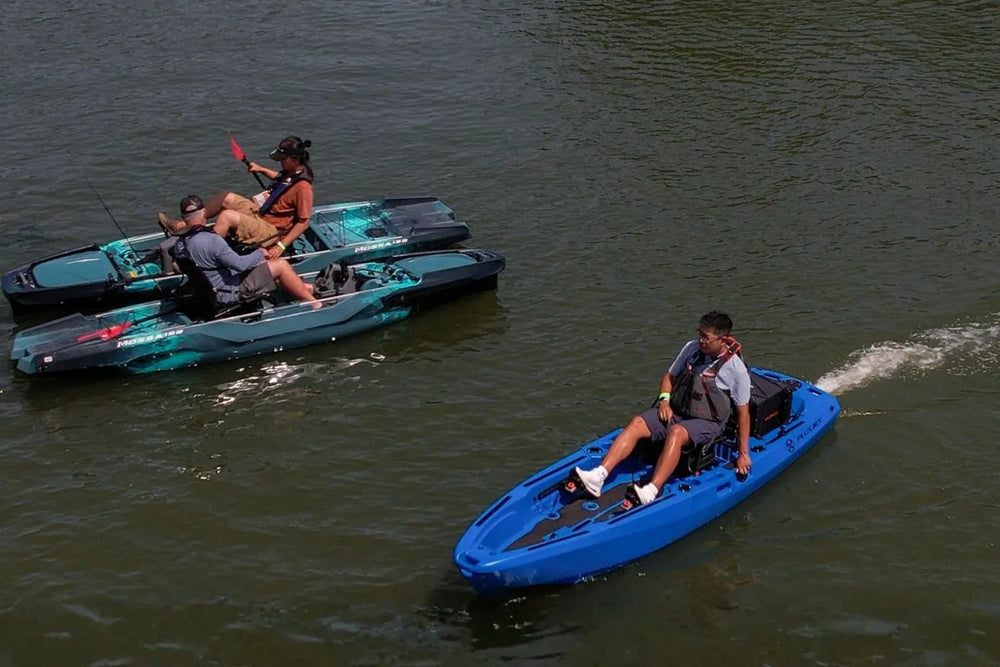
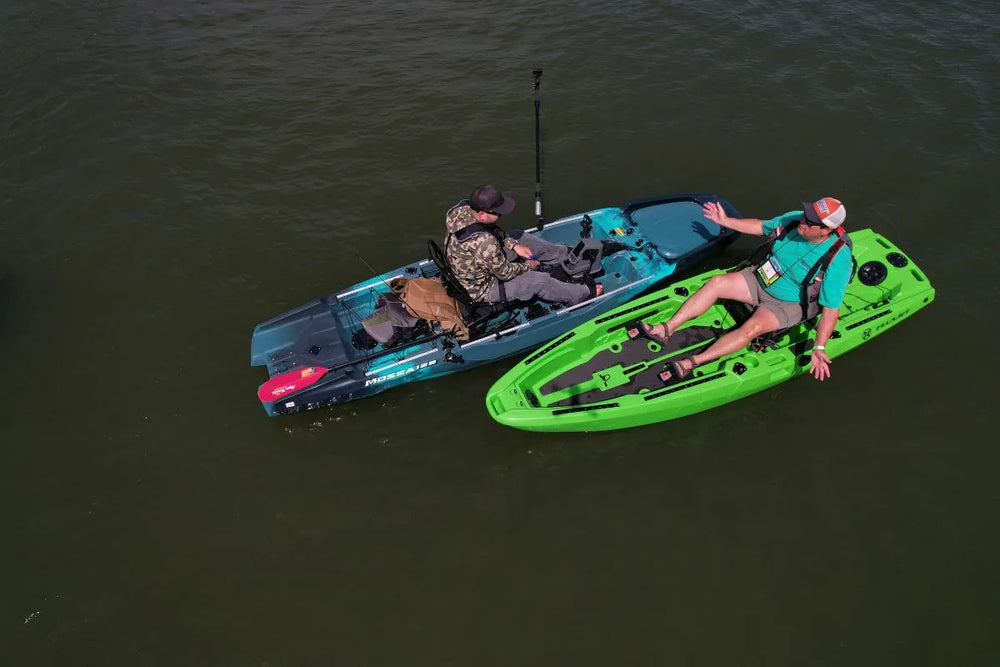
Where the VoyaX Mossa wins
- Pedal and motor in one
- If you want to pedal for exercise and switch to electric when you're tired, that's exactly what the Mossa is built for.
- Built-in SpotHold
- GPS position holding is built into the drive, so you don't need a separate anchor system.
- Capacity and size options
- 580 lb capacity on the 128, and a smaller 9'7" Mossa 97 if storage is tight.
- Battery in the box
- The 48V battery and charger come with it. With FluxJet you buy your own battery.
Where FluxJet wins
- Skinny water
- FluxJet runs in about 4 inches with nothing below the hull. With the Mossa, shallow sections mean pulling the drive and paddling.
- Weeds
- No prop and no pedal fins to wrap. The intake can still pick up weeds: slow down in thick vegetation and use reverse to help clear it.
- Your battery, your range
- Any standard marine battery from 12V to 60V. Go lighter for short trips or bigger for long days. See our battery guide.
- Lighter to load
- Rigged and ready, before the battery, a FluxJet is 122 lb. A Mossa 128 is 151 lb before its battery and 164 lb with it. That difference matters every time you lift it onto a rack or a truck bed.
- No pedaling at all
- A throttle dial and foot-pedal steering. Nothing to pedal, so it suits anglers who'd rather not.
The honest verdict
Pick the one that fits your water
If you want to pedal, need built-in GPS position holding, and mostly fish open water deep enough for a drive below the hull, take a serious look at the VoyaX Mossa. It's a well-designed kayak that solves real problems.
If you want pure electric simplicity, fish skinny water or weedy flats, and want to pick your own battery, the FluxJet is the better fit.
Questions
FluxJet vs Mossa FAQ
Does the FluxJet have GPS anchoring like SpotHold?
Can the VoyaX Mossa run in shallow water?
Which one costs less?
Can I pedal a FluxJet?
Which one is better in weeds?
Still deciding? Talk it through with us.
Call the team that builds every FluxJet. We'll answer honestly, even when the other kayak is the better fit.